
London offers several departure points for private aviation, but choosing between them can have a substantial effect on the journey. An airport that is convenient for a passenger travelling from Mayfair may be a poor choice for someone leaving from Surrey or Kent. Operating hours, aircraft availability and ground transport also influence which departure point makes the most sense.
Unlike scheduled airlines, private charter operators can arrange flights from different airports according to the requirements of individual passengers. This flexibility makes it possible to select a departure point that suits a particular itinerary rather than travelling to an airport simply because a commercial airline operates there. However, not every airport can accommodate every aircraft or departure time.
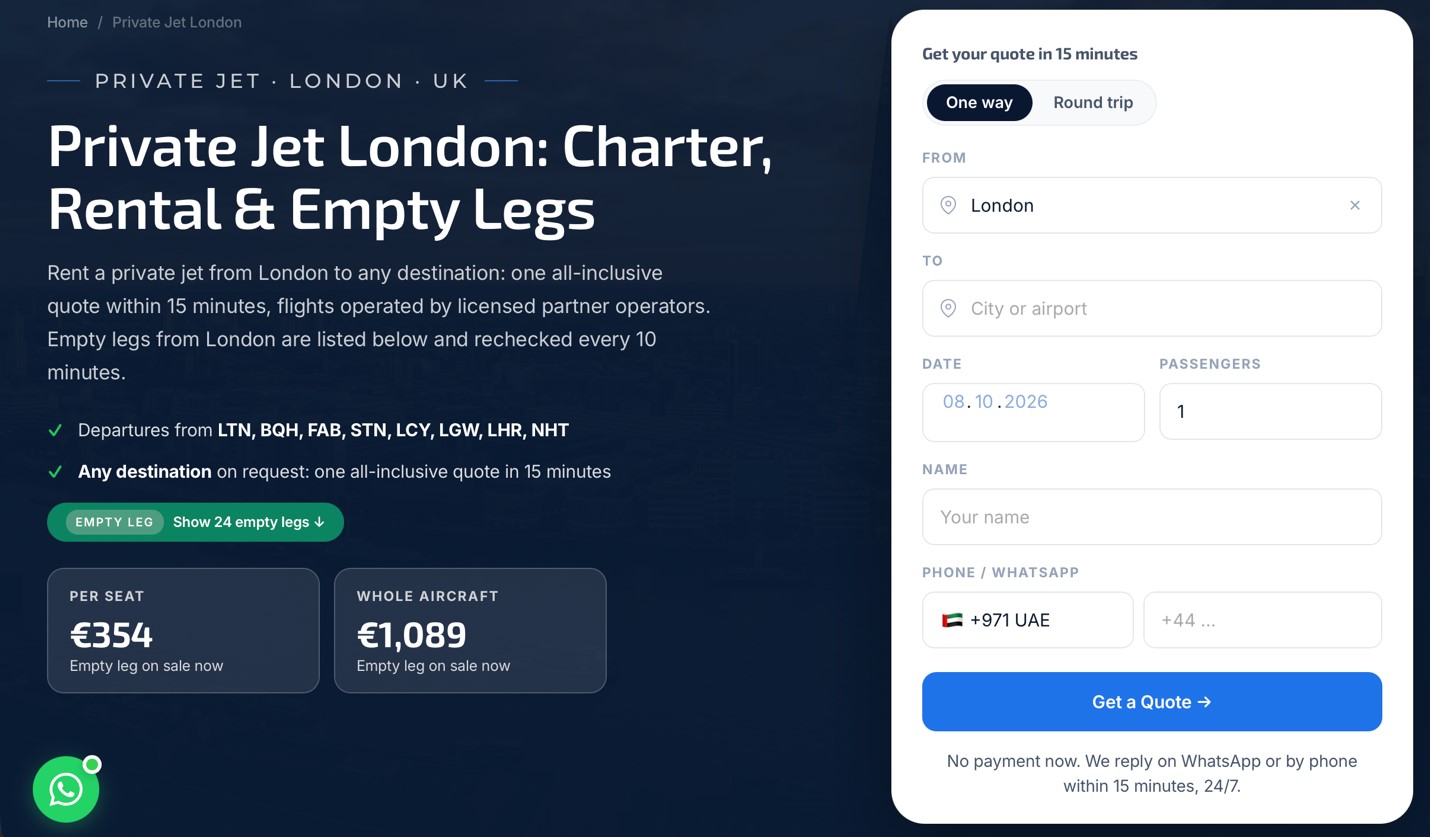
The choice of airport is therefore one of the first decisions involved in arranging a private flight. Passengers exploring https://rentjet.eu/private-jet-london/ can consider several London-area departure points, including Farnborough, Biggin Hill, Luton and Stansted. Each has distinct advantages, and the right option depends on where the journey begins, where it ends and what type of aircraft is required.
Farnborough Airport for Dedicated Business Aviation
Farnborough Airport is located in Hampshire, southwest of London, and specialises in business aviation. Unlike airports with extensive scheduled passenger operations, Farnborough is designed around private and corporate aircraft. Its infrastructure supports passengers who value discreet terminal facilities and a relatively straightforward transition between ground transport and the aircraft.
The airport can be particularly convenient for travellers based in Surrey, Hampshire and parts of west or southwest London. For someone leaving from Guildford, Woking or a nearby business location, Farnborough may involve considerably less road travel than an airport on the other side of the capital. Passengers departing from central London should assess road conditions carefully, especially when travelling during weekday peak hours.
Farnborough accommodates a variety of business aircraft, making it suitable for numerous European and longer-distance journeys. Its facilities include dedicated passenger handling and services for flight crews. The environment is focused on private aviation rather than commercial passenger traffic, which can make departure arrangements more straightforward for charter customers.
One important limitation concerns operating hours. Farnborough generally operates from 07.00 to 22.00 on weekdays and from 08.00 to 20.00 at weekends and on bank holidays, with closures on Christmas Day and Boxing Day. These restrictions matter for passengers planning late returns or early departures. Charter arrangements must fit within the airport’s permitted operating schedule.
Farnborough is a strong candidate when dedicated business aviation infrastructure and access from southwest London are priorities. It is less compelling when reaching the airport requires a lengthy journey across the capital, particularly if another suitable departure point offers comparable aircraft availability.
Biggin Hill Airport for South and Southeast London
London Biggin Hill Airport occupies a different position in the capital’s private aviation network. Located in the London Borough of Bromley, it provides dedicated business aviation services within Greater London. Its location can be especially useful for passengers travelling from south London, southeast London and parts of Kent.
The airport offers facilities designed for private aircraft operators and their passengers. Travellers can use dedicated business aviation terminals rather than the main passenger buildings associated with large commercial airports. This arrangement supports relatively efficient departures, although security, customs and immigration requirements still apply where relevant.
Biggin Hill can also be considered by passengers working in central London, particularly when their departure point makes the journey southeast practical. Nevertheless, road connections should be evaluated according to the actual starting address. A passenger leaving from Knightsbridge may have a different experience from someone departing from Canary Wharf, and neither should assume that geographic proximity guarantees a shorter transfer.
The airport’s runway is approximately 1,800 metres long, which makes aircraft performance an important consideration. Many business jets can operate there, but suitability depends on aircraft type, weight, weather conditions and the intended route. Longer-range flights with substantial fuel and passenger loads may require additional planning or a different airport.
Biggin Hill also has defined operating hours. The published schedule permits operations from 06.30 to 23.00 on weekdays and from 08.00 to 22.00 on weekends and bank holidays. These hours may accommodate a broader range of departure times than some alternatives, although the proposed flight must still meet all applicable operational requirements.
For passengers based south or southeast of London, Biggin Hill deserves serious consideration. Its combination of dedicated facilities and location can make it an effective departure point for European business travel, weekend holidays and other private charter journeys.
Luton Airport for North London and Hertfordshire
London Luton Airport is widely associated with commercial airlines, but it also has an established business aviation sector. Specialist operators provide private aircraft handling, passenger lounges and services separate from the main airline terminals. This combination allows private aviation to operate alongside a substantial scheduled flight programme.
Luton is particularly relevant for travellers based in north London, Hertfordshire and neighbouring areas. Passengers leaving from St Albans, Harpenden or parts of north London may find it more convenient than travelling southwest to Farnborough. The airport is also accessible from central London, although transfer times depend heavily on the departure address and traffic conditions.
Several fixed-base operators, commonly known as FBOs, support private aviation at Luton. These companies coordinate aircraft handling and provide passenger facilities, with services varying between terminals. Some facilities offer dedicated lounges, catering arrangements, meeting spaces and direct access to aircraft parking areas.
The presence of multiple business aviation providers gives operators different handling options, but passengers should not assume that all terminals offer identical services. Facilities, staffing arrangements and access procedures may differ. The charter company should confirm which terminal will be used and where the passenger’s driver should arrive.
Luton’s combination of private aviation infrastructure and commercial airport operations also creates practical considerations. Aircraft movements are subject to air traffic procedures and available airport capacity, while environmental restrictions and scheduling requirements can influence operations. Passengers requesting departures at particularly busy times should allow the charter operator to confirm the proposed schedule before making other commitments.
Luton is worth considering for journeys originating north of London, especially when a suitable aircraft is already available there. Its usefulness ultimately depends on the combination of location, aircraft positioning and airport arrangements rather than any single feature of its facilities.
Stansted Airport for Larger and Longer-Range Flights
London Stansted Airport is situated northeast of the capital in Essex. Although it handles significant commercial passenger traffic, it also has substantial infrastructure for business and general aviation. Its long runway and specialist ground-handling facilities make it a relevant option for a wide range of private aircraft.
One of Stansted’s advantages is its suitability for larger aircraft. Long-range business jets and corporate aircraft with greater operating requirements can use the airport, subject to the relevant permissions and operational conditions. This can be particularly valuable for international flights where aircraft size, range and fuel requirements influence the choice of departure point.
Private aviation passengers use facilities provided by specialist handling companies rather than necessarily passing through the main commercial terminal. These facilities can include separate passenger lounges, aircraft handling services and arrangements for international arrivals and departures. The exact experience depends on the operator and the handling provider selected for the flight.
Stansted can be convenient for travellers based in Essex, northeast London and areas around Cambridge. For passengers located southwest of London, however, reaching the airport may involve considerable road travel. A technically suitable airport is not always the most sensible choice if ground transport adds unnecessary time to an otherwise convenient journey.
The airport’s infrastructure is particularly relevant when operators need to accommodate larger aircraft or specific long-range flight requirements. Even so, runway capability alone does not guarantee the availability of a particular departure time. Commercial traffic, airport procedures, aircraft parking arrangements and operational permissions must all be taken into account.
Stansted should be considered when aircraft requirements or passenger location make it advantageous. For a short European journey with a small group, another airport might be more convenient, while a larger international charter could justify the additional ground transfer.
How to Choose Between London’s Private Airports
There is no single best departure airport for every private jet passenger. Each of the four airports serves a different combination of geographic areas, aircraft requirements and operational needs. A useful comparison starts with the complete journey rather than the flight alone.
The following factors deserve consideration before selecting an airport.
- Departure location. Compare realistic ground transfer times from the passenger’s home, office or hotel rather than relying only on distance.
- Aircraft suitability. Confirm that the airport can accommodate the selected aircraft under the expected operating conditions.
- Flight schedule. Check published operating hours, restrictions and the availability of the requested departure time.
- Aircraft positioning. Establish whether the aircraft is already nearby or must fly to the departure airport without passengers.
- Handling facilities. Identify the private terminal and confirm its passenger services, access arrangements and opening hours.
- Total charter cost. Compare airport charges, positioning expenses and any differences between the available aircraft.
Aircraft positioning can be particularly influential. If two suitable jets are available for the same journey but one is based at Luton and the other must be flown empty to Farnborough, the resulting quotations may differ. That does not automatically make Luton the better option, because passenger transfer time and other operational costs also matter. It does demonstrate why comparing airports and aircraft together can produce more useful results than choosing an airport first and considering everything else afterwards.
The destination can influence the decision as well. Some journeys require larger aircraft or particular operating capabilities, while others can be completed comfortably by smaller jets. A charter broker can assess which airports and aircraft combinations are feasible before the passenger makes a final choice.
Travellers should also distinguish between an airport’s general operating hours and the availability of an individual charter. An airport may be open while the preferred aircraft, crew or handling service is unavailable. Conversely, an alternative airport may provide a suitable departure even when the first choice cannot accommodate the requested itinerary.
For passengers based in southwest London or Surrey, Farnborough may provide the most convenient combination of location and dedicated facilities. Biggin Hill can be particularly attractive from south and southeast London, while Luton is a practical candidate for northern districts and Hertfordshire. Stansted is worth examining for journeys from the northeast and for flights requiring larger aircraft.
These are starting points rather than fixed rules. The most useful airport comparison is based on actual transfer times, confirmed aircraft options and the full charter quotation. Selecting a departure point on those grounds helps ensure that the convenience of private aviation extends beyond the aircraft cabin to the entire journey.